
Women in Comics: This One Summer


I chose the graphic novel This One Summer, written by Mariko Tamaki and illustrated by Jillian Tamaki, for my reading about women in comics this week.

 This One Summer struck me with how effectively it deals with the awkward transition phase of the early teenage years. The comic shows a version of everyday life that selectively focuses on the subjects it wants to deal with, like sexuality, seeing parents as flawed, and wanting to be older but not really knowing how. The art style suits the message well too, with the lines drawn as rounded shapes to make the comic feel friendly overall, but still using shading/tones and skillful acting to show more emotional moments. 

One thing very unexpected about This One Summer was actually its reviews. I checked the reviews because I was interested in how others might react to this somewhat controversial book (an early teen slice-of-life with some very mature themes). I was surprised to find that many people didn't like the book at all because they thought "nothing happened"–they felt there was no distinct climax, and Rose never apologizes for her slut-shaming or learns a concrete lesson. 
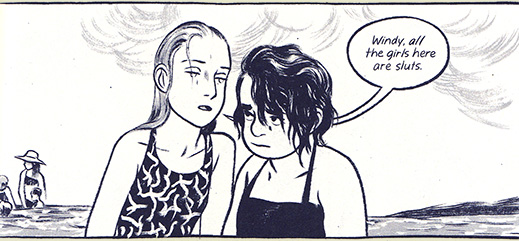

I disagree very strongly with these reviews. Rose did learn lessons, but they aren't handed to the reader on a plate, and they aren't concrete for Rose either because that's not how teens–or most people–work. For example, Rose yells for her mother during her biggest time of distress after rejecting and distancing herself from her mother for most of the book. She also begins to see how badly Duncan is behaving towards Jenny, who she had been condemning as a "slut" in order to hold onto an idealized fantasy of her crush. 

If at the end of the novel Rose was shown gaining clear understanding of all these muddled and difficult life lessons, that would have actually weakened the narrative. It would be untrue to the confusion of teen years, and would set up unrealistic expectations of how quickly teens should be able to get a grasp on adult life. 


Comments

Popular posts from this blog

European Comics: Blacksad

Today I read the first book of  Blacksad , an edgy French comic written by Juan Diaz Canales and illustrated by Juanjo Guarnido. The   comics follow a panther detective through a series of anthropomorphic noir mysteries. I really enjoyed Blacksad . The story is a fairly standard mystery, but Blacksad's voice is engaging and authentic as a noir narrator, and the artwork is amazing. I felt that the art style was especially effective because it helps immediately establish character personalities--the criminals are rats and scaly creatures, the sheriff is a border collie, etc. I also tend to find that in noir movies or comics all the characters tend to look the same (all the men are square-jawed and serious, the women attractive and curvy) and the style of  Blacksad helped prevent this from happening for me. Guarnido also does a fantastic job at using different shot angles and engaging acting within the panels. I enjoy this kind of visual storytelling much ...

Reconsidering the Superhero: Watchmen

This week I read the first issue of  Watchmen by Alan Moore. I was surprised right off the bat by how dark and overtly political the comic was. Right in the opening scene,  Rorschach talks bitterly about "the accumulated filth" of the city drowning in blood. For a comic from as big a publisher as D.C. to display such cynicism, I can definitely see how Watchmen expanded the genre in comics.  One thing I really enjoyed about Watchmen that I don't see in other comics is how dark the humor is. As we see in the beginning of the comic,  Rorschach often delivers monologues via a diary he keeps. This is often where Moore's sense of humor can be seen. In one scene, for example,  Rorschach spends a disproportionate amount of time talking about how many kids his neighbor has and how she is probably abusing welfare–it's funny because of how small an issue it is that  Rorschach is devoting his energies to.  Rorschach also comes across as a bit comedic to me bec...

The Killing Joke: Questions

Answers to the in-class reading questions. 1. What is your reaction to the text you just read (Batman: The Killing Joke)? I enjoy comics with more of a serious tone, and this was one of them. While I've seen the Batman universe portrayed pretty grimly, however, I was shocked by just how dark The Killing Joke gets--Gordon is dragged naked by a collar and is shown nude photos of his daughter after she was shot. This was much more sexually explicit than I am used to seeing with big name comics like Batman, too. I've seen sex scenes in these comics, but not sex used as the disturbing element it is in The Killing Joke. 2. What connections did you make with the story? Discuss the elements of the story with which you were able to connect. One thing I enjoyed a lot about The Killing Joke was the pacing and the switches between the present and the past in the Joker's life. The comic set up a good mystery within both timelines that really drew me in and made me want to kee...